
The General Laws AML/CFT Amendment Bill, 2026: What Accountable Institutions Need to Know
B15-2026 proposes targeted changes to FICA, beneficial ownership, record-keeping, technology risk and financial intelligence as South Africa prepares for FATF 2027.
1. The background: why B15-2026 matters
The General Laws (Anti-Money Laundering and Combating Terrorism Financing) Amendment Bill, 2026 [B15-2026] forms part of South Africa’s continued strengthening of its AML/CFT framework following the FATF greylisting process.
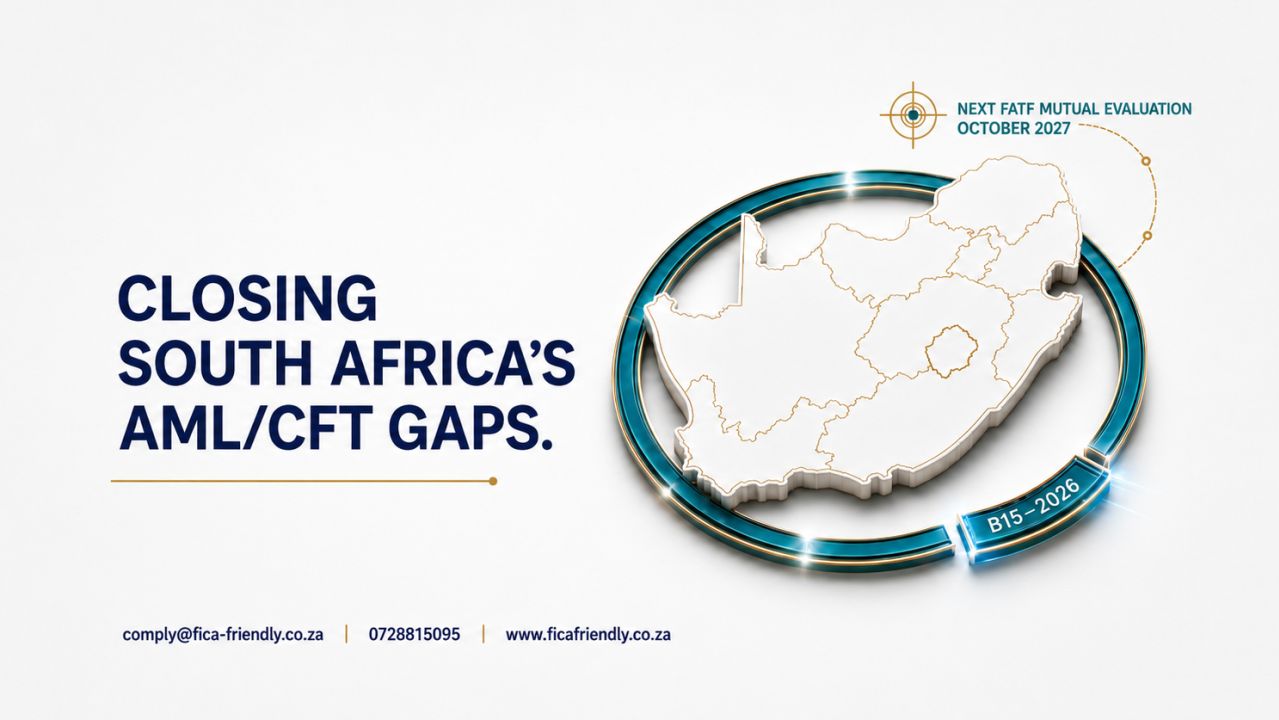
South Africa exited the FATF greylist in October 2025, but that did not conclude the reform process. B15-2026 is intended to address remaining deficiencies identified during the 2021 FATF Mutual Evaluation and subsequent remedial process, while strengthening South Africa’s framework ahead of the current FATF Mutual Evaluation, expected to conclude in October 2027.
“The Republic needs to address the outstanding deficiencies that were identified during the FATF enhanced follow up process.”
~ Memorandum on the Objects of B15-2026
For accountable institutions, the Bill is particularly relevant because several of the proposed amendments affect the practical infrastructure through which FICA compliance is implemented: record-keeping, technology risk, targeted financial sanctions, beneficial ownership information, information sharing and the information available to the Financial Intelligence Centre.
The Bill extends beyond FICA and also proposes amendments to the Companies Act, Close Corporations Act, Nonprofit Organisations Act and Financial Sector Regulation Act.
Importantly, B15-2026 is proposed legislation. It is not yet law.
2. Where is B15-2026 in the parliamentary process?
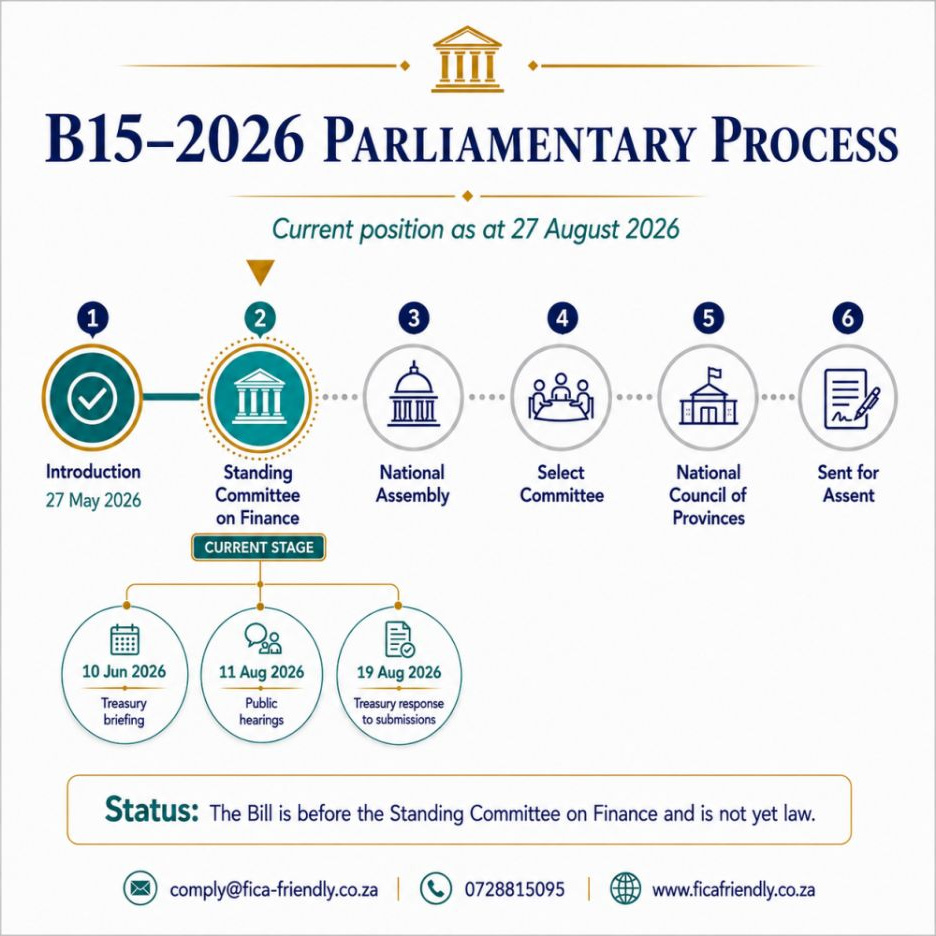
The Bill was introduced in the National Assembly on 27 May 2026 and referred to the Standing Committee on Finance.
Since then:
- 10 June 2026: National Treasury briefed the Standing Committee on Finance.
- 11 August 2026: Public hearings were held.
- 19 August 2026: National Treasury responded to submissions received on the Bill.
As at 27 August 2026, the Bill remains at committee stage and has not yet been passed by the National Assembly.
Because the Bill has progressed through the parliamentary process, accountable institutions should understand the proposed amendments, consider their potential operational impact and monitor its progress so that they are positioned to respond if the proposals become law.
3. What is being proposed?
i. Longer FICA record-keeping
The Bill proposes extending relevant FICA record-retention periods from five years to seven years.
What this could mean: Institutions may need to review their RMCPs, retention policies and systems to ensure CDD, transaction and reporting records remain complete and retrievable for the required period.
ii. New technologies and service-delivery methods
Accountable institutions would expressly be required to consider ML/TF/PF risks associated with new or developing technologies and new delivery mechanisms before introducing relevant products or services.
What this could mean: Digital onboarding, remote verification and technology-enabled services should be supported by an appropriate risk assessment and corresponding controls.
iii. Beneficial ownership information
The Companies Act amendments propose a framework under which prescribed obliged entities may be required to report material discrepancies in beneficial ownership information to CIPC.
What this could mean: Beneficial ownership information is increasingly expected to be reliable and capable of verification, rather than simply recorded from a client declaration.
iv. Expanded FIC information and intelligence powers
The Bill proposes broader information-gathering and information-sharing powers for the FIC, including provisions relating to lifestyle audits and access to information from public bodies and accountable institutions.
What this could mean: The quality and accuracy of information collected and retained by accountable institutions becomes increasingly important within the wider national financial intelligence framework.
v. Targeted financial sanctions
The proposed amendments expand certain reporting requirements relating to designated persons and entities, including relevant attempts or enquiries to transact.
What this could mean: TFS procedures should address screening, escalation, attempted transactions and reporting, rather than focusing only on confirmed matches.
vi. Information sharing between accountable institutions
The Bill also proposes permitting information sharing between accountable institutions in specified circumstances where this may assist compliance with particular FICA obligations, subject to applicable protections.
What this could mean: The proposals point toward a more connected AML/CFT information environment, while increasing the importance of appropriate governance over how information is shared and protected.
4. What should accountable institutions do now?
B15-2026 should not be treated as though its proposed provisions are already binding.
It does, however, provide a useful indication of the direction in which South Africa’s AML/CFT framework is developing.
Accountable institutions should consider whether their existing compliance foundations are already sound:
- Does the RMCP reflect how the institution actually operates?
- Are records complete, accessible and appropriately retained?
- Is beneficial ownership properly established and verified?
- Have technology and non-face-to-face risks been assessed?
- Are TFS screening, escalation and reporting procedures clear?
- Is the quality of client information sufficient to support the institution’s risk-based approach?
The immediate priority is therefore not premature implementation of B15-2026, but ensuring that existing FICA obligations are properly implemented while remaining ready to adapt as the Bill progresses.

5. How FICA Friendly can assist
FICA Friendly assists accountable institutions with:
- RMCP development, review and updating
- Business-wide risk assessments
- Client due diligence and beneficial ownership controls
- Technology and non-face-to-face risk
- Record-keeping frameworks
- PEP and targeted financial sanctions procedures
- FICA training, implementation and compliance remediation
Our focus is on translating regulatory requirements into practical controls that reflect how an institution actually operates.
To discuss your institution’s current FICA compliance framework or readiness for the direction of these reforms, contact FICA Friendly on 0728815095.
B15-2026 remains proposed legislation and is not yet law.